
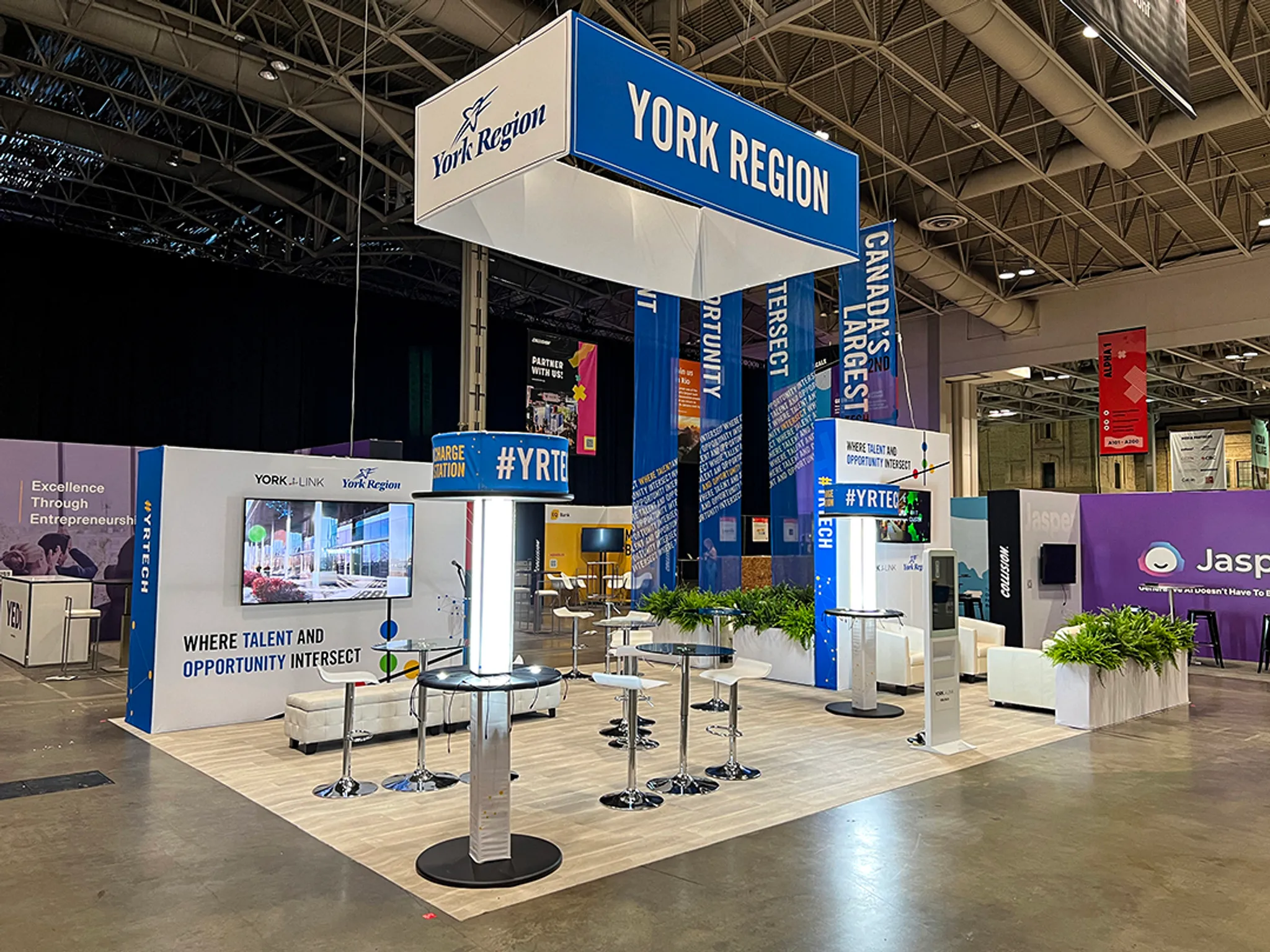
Advance Warehouse and Logistics Planning ties the build, graphics, AV, labor, and floor supervision into one delivery.
The Grove of Anaheim changes what is realistic. ACC halls support large format with heavy rigging. The format has to fit the room it lands in.
What we focus on
- Sponsor deliverables, signage kits, and branded moments tracked against the organizer's prospectus and deadlines.
- Staffing plans, lead capture hardware, and badge scanning built into the same operations schedule as the room build.
- One floor lead on-site from load-in through the final tear — same person responsible for every change order.
Scope on a corporate event services project
a bad one has many, because they weren't.
Out of scope by default are show organizer fees, booth lease costs paid directly to the show, staff travel and per diems, and any custom software or data-capture tooling the client runs on its own stack. Those stay on the client side and plug into the project through coordination, not rebilling.
What Corporate Event Services actually requires
Corporate Event Services programs succeed when the attendee path is decided first — registration, main moments, sponsor activations, demo stations, breakout rooms, and the reset windows between them. The booth, the staging, and the technical plan all flow from that path.
Advance Warehouse and Logistics Planning becomes the connective tissue: fabrication, graphics, labor, AV, and freight moving against the same schedule as the content program.
The Grove of Anaheim changes what is realistic. ACC halls support large format with room for heavy rigging. Resort-hotel ballrooms constrain ceiling height and stage size. The format has to match the room it lands in.
How the room gets built
Public-facing moments stay separated from back-of-house setup. Crew, freight, and change-orders move behind a curtain line so the attendee-facing space stays clean. Reset windows between sessions are scheduled the same way as the sessions themselves.
Lead capture, badge scan integration, and staffing sit on the same operations schedule as the room build. That keeps the sales motion tied to the attendee path rather than bolted on the morning of the show.
One floor lead owns live changes. If a sponsor adds a last-minute activation, one person decides feasibility, orders the labor, and updates the schedule.
- Attendee path mapped before room layout
- Back-of-house reset windows scheduled like sessions
- Technical production (lighting, audio, video) integrated with the build
- Lead capture and staffing on the same calendar as the room
- One floor lead for live change orders
What Anaheim adds
Exhibit Halls total 813,607 square feet, and the Arena provides 28,140 square feet of flat-floor space. That scale means the audience is often splitting attention across multiple shows happening the same week. Programs that hold attention tend to be the ones with clean sequencing and strong staging, not just heavy spend.
The Grove of Anaheim is a useful reference point for how Anaheim venues handle freight, labor, and service ordering at scale. The scale also means rigging, power, and floor management are real projects in themselves, not afterthoughts.
For resort-hotel ballroom events, the program typically relies on the hotel's AV contract or brings in outside AV with a carve-out. We check that early because it changes the budget significantly.
What organizers and sponsors ask first
Visibility, timing, attendee flow, and whether the format gives each sponsor moment enough room to actually work. Those are the four questions. Everything else is downstream.
A good program brief answers them with specifics: "Main stage opens at 9 AM for 45 minutes, then attendees cycle through the sponsor hall for 90 minutes, then three parallel breakouts for an hour." Not "we'll keep the energy up."
The goal is a format the client can explain in two sentences and the crew can execute without improvisation.
Frequently asked questions
How does labor work in Anaheim?
It runs venue by venue.
How much lead time is ideal?
Custom builds run best with 16 to 20 weeks of lead time. Rentals take 8 to 12 weeks.
What information kicks off a project?
The show, The venue, The booth number, the dates, and a target budget range. From those, an initial scope and a realistic cost come back within a few days.
Who runs The booth on-site?
One named show-site lead runs the install, the show hours, and the strike. That person carries the floor plan and the punch list from crates to doors and reports up once a day.
Can The booth travel to the next city on our calendar?
Same structure, swappable graphics, standard crates.